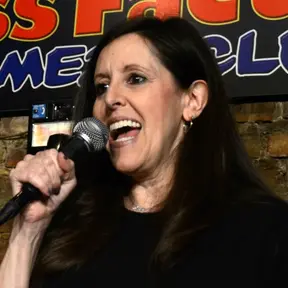
Wendy Liebman
She hides the sharpest jokes in the silence after the punchline.
2 specials · 1996–2024
Get an email when there's a new special. You'll need a Google account.
Wendy Liebman works backward from the pause. She will deliver a functional punchline, wait for the audience to start laughing, and then quietly drop an afterthought that flips the entire premise. Her setups are polite and conversational, delivered with the bright, slightly bemused tone of someone making small talk at a neighborhood party. Then she stops, lets the room get comfortable, and mutters the actual joke just as the noise starts to fade.
Specials
-
Comedy Dynamics · 44 min
On stage
She has been refining this specific mechanic since the mid-eighties Boston comedy boom. While other comics of her era shouted to be heard, she figured out that speaking softly makes a room lean in. She remains a fixture in clubs across the country, a steady presence who shows younger comics how to hold a crowd without raising your voice.
The material stays close to home: marriage, aging, family dynamics, and daily annoyances. She uses her unthreatening demeanor as cover. She will start what sounds like a mild anecdote about her husband, tag it with a dark, deeply cynical realization, and then move cheerfully to the next thought. She trains the audience to listen actively. They learn quickly that the real punchline is usually hiding in the silence at the end.
She studied psychology before taking an adult education comedy class in Cambridge. It is a fitting background for someone who treats joke structure like a behavioral experiment.
At a glance
- Topics