The Wednesday letter , , 4 min read
CBS Swaps Stephen Colbert for Cheap Syndication
CBS has replaced Stephen Colbert with a twenty-year-old panel show to save forty million dollars, proving the spreadsheet has defeated the monologue.
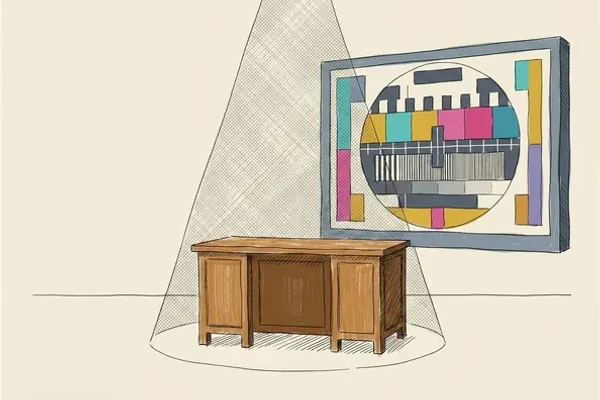
The spreadsheet has officially defeated the monologue.
One week after Stephen Colbert hosted his final broadcast of The Late Show, CBS released a statement that felt less like a farewell and more like a corporate high-five in an empty hallway. The network announced that by replacing Colbert with Byron Allen’s syndicated Comics Unleashed, they had successfully transformed a time slot that was losing forty million dollars annually into one generating fifteen million in profit.
This is what television executives call a fifty-five million dollar swing.
It is also what comedians call the end of an era. CBS is no longer in the business of paying for writers, elaborate house bands, or hosts who read daily news summaries. Instead, they are leasing the eleven thirty-five time slot to Allen’s media company, which will air a twenty-year-old panel show and handle selling all the ads. It is the ultimate time-buy model, turning one of the most culturally significant hours in American broadcasting into the media equivalent of a late-night infomercial for cheap real estate.
Naturally, not everyone is buying the math.
Jimmy Kimmel, speaking to reporters this week, pointed out the obvious flaw in CBS’s accounting. He noted that the network had offered Colbert a multi-year extension in twenty-three, raising the rhetorical question of whether a network would willingly renew a show that was bleeding tens of millions of dollars a year. Kimmel flatly called the reported losses made-up numbers.
Whether the forty million figure is creative accounting or a convenient cover story for a network trying to clean up its balance sheet ahead of a corporate merger, the result is the same. Late-night television as a high-stakes, big-budget cultural battleground is dead.
In its place, we have syndication. Comics Unleashed is a perfectly functional show that features mostly lesser-known comedians performing tight, five-minute sets. It is efficient, it is cheap, and it requires absolutely no administrative overhead from CBS.
It is a television show designed by an algorithm that hates television.
Ben Gleib Builds a Late-Night Show in His Living Room
While CBS is busy retreating from the late-night format, independent creators are attempting to rebuild it out of spare parts.
Last Thursday, comedian Ben Gleib launched Good Night with Ben Gleib on YouTube, advertising it as the platform’s first creator-led late-night talk show. The entire production is run out of Gleib’s home in Los Angeles.
If CBS represents the corporate consolidation of television, Gleib’s show represents the chaotic decentralization of it. Instead of a multi-million-dollar studio, the set is a repurposed room in a residential house. Instead of a studio audience, a projection screen shows a grid of digital ticket-holders watching from Zoom. The house band is led by Keith Harris, formerly of the Black Eyed Peas, who is presumably playing at a volume that won’t trigger a noise complaint from the neighbors.
The show’s structure is a fascinating hybrid. It keeps the traditional late-night elements, including an opening monologue and desk interviews, but stretches them to fit the loose boundaries of the internet. The debut episode featured a half-hour conversation with filmmaker Kevin Smith, followed by a roundtable with comedians Zainab Johnson and Brent Pella. When the cameras stopped rolling, Gleib simply walked to another part of his house to host an online after-party.
This is late-night produced for about twenty-five thousand dollars an episode.
It is an admirable experiment in scale, even if the economics of creator-led late-night remain unproven. While a broadcast late-night clip can easily rack up millions of views, a full-length, hour-long talk show on YouTube faces a steep climb to find a consistent audience.
But the contrast is beautiful. On one hand, a legacy network is paying a syndicator to broadcast old stand-up clips to avoid paying a writing staff. On the other, a comedian is begging people on Zoom to watch him interview Kevin Smith in his living room.
The future of the medium probably lies somewhere in the middle, but the living room is a much funnier place to start.
Sam Campbell’s Absurdist Film School
The mockumentary format has been dead for at least a decade, but nobody told Sam Campbell.
The Australian absurdist, fresh off destroying the competitive integrity of Taskmaster, launched his new six-part comedy series Make That Movie on Channel Four last Thursday. It is a television show that feels like it was written during a fever dream and edited by someone who has only had the concept of film explained to them once.
It is also the funniest television show of the year.
The premise is brilliantly idiotic. Campbell plays a fictionalized, pompous version of himself, a former hotshot film director who travels the country in a van to find ordinary citizens with terrible movie ideas, which he then promises to produce in three days. In the premiere episode, the team meets Mick Hall, a print shop worker with a bulletproof script about a married couple who can turn into snakes.
The catch is that only one of them can turn into a snake at any given time, meaning they can never actually be snakes together.
Campbell’s solution to this narrative challenge is to smash Mick’s print shop with a sledgehammer, recruit the bewildered staff as actors, and fly the entire production to the United Arab Emirates on a budget that seems to consist entirely of goodwill and cardboard. The show works because it ignores the standard rules of comedy pacing.
Campbell is flanked by a stellar supporting cast, including Lara Ricote as his hyper-supportive assistant Jess, and Aaron Chen as an incredibly serious intimacy coordinator named Sebastian. There are no warm, human moments here. There is only a relentless dedication to the bit, involving animated feet, bizarre AI chatbots, and a cast of amateur actors who are aggressively bad at performing.
Channel Four apparently gave Campbell and director Joe Pelling complete creative freedom because the production team was too busy working on a cartoon about cats for Ricky Gervais to notice what they were doing.
We should all be grateful for the distraction.