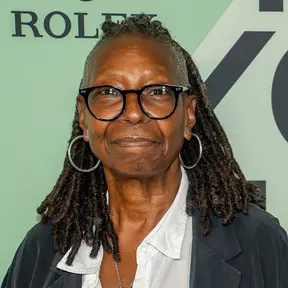
Whoopi Goldberg
She disguises pure character acting as a night of standup.
3 specials · 1990–2005
Get an email when there's a new special. You'll need a Google account.
Whoopi Goldberg does not step up to the microphone and fire off premises. She walks out in loose clothes, pulls up a stool, and drops into a different human being. Without a costume change, a shift in posture and a dropped octave turns her into Fontaine, a cynical street philosopher. A white shirt draped over her head turns her into a young Black girl pretending to have long, flowing hair. The comedy emerges from the reality of the characters, who speak directly to the crowd, asking questions and challenging the room. There are no traditional punchlines, just the steady rhythm of a specific person talking.
Specials
-
Whoopi: Back to Broadway - The 20th Anniversary
A return to the 1984 stage characters that launched her career.
HBO · 1 h 30 min
-
Whoopi Goldberg & Billy Connolly: In Performance with Billy Connolly
An American star introduces a Scottish comedy institution to the States.
HBO
On stage
Because she is an EGOT winner and a permanent fixture of morning television, entire generations encounter her only as a broadcaster or a movie star. But in the early 1980s, she brought a downtown theater sensibility to mainstream comedy. She showed that a performer could fill a Broadway theater just by sitting in a chair and acting.
When the material works, it feels like eavesdropping. She pulls laughs from heavy subjects—addiction, physical disability, heartbreak—because she never winks at the audience. She stays strictly inside the character’s point of view. Her weakness on stage is a tendency to lean on sentiment. In her later revivals, the political commentary sometimes flattens out into broad statements designed to elicit agreement rather than laughter. But the physical performance never wavers. Even when a monologue veers into earnestness, the person sitting on the stool feels entirely real.
Turning points
-
1984–1985
Broadway Debut and Grammy Victory
Mike Nichols discovered Goldberg performing her solo 'Spook Show' and brought it to Broadway; the recorded album won a Grammy Award, making her the first Black female comedian to win Best Comedy Album.
-
Breakout Film Stardom in The Color Purple
Steven Spielberg cast Goldberg as the lead in 'The Color Purple' after seeing her perform, earning her a Golden Globe win and an Academy Award nomination.
-
Oscar Win for Ghost
Her role in 'Ghost' earned her the Academy Award for Best Supporting Actress, making her only the second African-American woman to win an acting Oscar.
At a glance
- Born
- , Manhattan, New York City
- On stage
- since 1982
- Style
- observational, satire, surreal, character, black comedy
- Breakout
- The Spook Show (Broadway show Whoopi Goldberg / Whoopi Goldberg: Direct from Broadway)
- Influences
- Moms Mabley, Lenny Bruce
- Topics
- Elsewhere
- Wikipedia
Fans also like
-
 Robin Williams
Robin Williams co-hosted nine historic Comic Relief benefit telecasts alongside Goldberg and contributed liner notes to her original Broadway album.
-
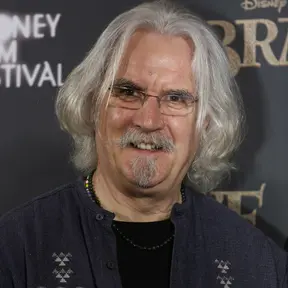 Billy Connolly
Goldberg teamed up with Billy Connolly for the 1990 joint performance special Whoopi Goldberg and Billy Connolly in Performance.
Also on screen
- The Color Purple
- Jumpin' Jack Flash
- 1988–1993
- Star Trek: The Next Generation
- Ghost
- Sister Act
A clip to start with

Whoopi Goldberg Stand Up - 2009