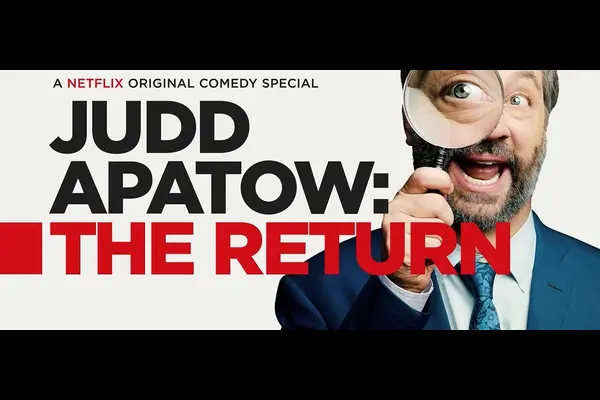
The Return
Netflix · 2017 · 69 min
A Hollywood giant tests his stand-up chops after twenty-five years away.
Judd Apatow spent decades behind the camera shaping the landscape of modern film comedy before realizing he missed the immediate, vulnerable feedback of a live crowd. The hook here is the bizarre, inescapable friction of being a wildly wealthy Hollywood kingmaker who desperately wants to project the vibe of an everyday neurotic. It is a show about a man trying to lower his salary and his self-esteem at the same time, finding humor in the gap between his massive material success and his persistent personal anxieties.\n\nFilmed during the Just for Laughs comedy festival in Montreal, the performance marks Apatow’s return to stand-up after a twenty-five-year hiatus. He walked away from the stage in 1992, convinced he was outmatched by his contemporaries Adam Sandler and Jim Carrey. It was only after directing Amy Schumer and watching her sneak off to perform club sets after long days on a film set that he felt the pull to return to the microphone.\n\nMuch of the set acts as a companion piece to his work on This Is 40, structured as a monologue about middle age and family life. Apatow jokes about his teenage daughters, a supercut of Jennifer Aniston’s nipples serving as his family’s yule log, and the realization that his aging affects his children just as much as himself. He also recounts the awkwardness of trying to make Barack Obama laugh and a brief, weird interaction with Paul McCartney. A darker segment on Bill Cosby and sexual abuse offers a somber edge to the self-deprecation, while a reading of a depressing poem he wrote as a teenager about his parents’ divorce highlights his talent for mining autobiography for discomfort.\n\nReception to the hour was mixed. While critics and audiences appreciated his warmth and behind-the-scenes stories, some felt the performance suffered from a clash of perspectives. It proved difficult to buy into his self-deprecating “hapless guy” persona when the material constantly reminded the audience of his immense wealth and celebrity access. His delivery occasionally showed the rust of a quarter-century break, but the set is a rare document of an industry titan stripping away his Hollywood buffer to see if he can still handle a room.
The set list
-
Living with three beautiful women at home
Contrasts his wife Leslie Mann and two daughters against himself, casting himself as the ugly troll in the corner whose daughters mock him with the Kardashians' higher net worth.
-
Reading a depressing childhood poem about his parents' divorce
Shares an earnest poem written at age ten, and cuts the audience's sympathetic sigh by reminding them, 'Don't be sad... I'm rich.'
-
Meeting President Barack Obama and Michelle Obama
Hoping the president would compliment his comedic genius, only for Obama to state that they love depressing movies like 'Funny People'.
-
Attempting to schedule lunch with Paul McCartney
Displays a photographic slide of McCartney putting his hands up defensively when Apatow asked for contact information to meet up.
-
Throwing the ceremonial first pitch at a New York Mets game
Recounts horribly botching the pitch in front of 50,000 spectators and realizing that humiliation would fuel his comedy career for decades.
-
Rejection by Jim Henson and Sesame Street
Jokes about the painful sting of early-career rejection when producers wanted his writing material but not his presence, feeling rebuffed by Kermit the Frog.
-
Bill Cosby and sexual misconduct
Delivers an extended commentary addressing Bill Cosby and allegations of sexual assault.
How it plays
- Tone
- Self-deprecating, witty, confessional, and amiable.
- On stage
- Self-deprecating, neurotic, and relatable dad who acknowledges his high-status wealth and fame while portraying himself as a low-status family man.
- Pace
- Amiable, conversational delivery characterized by episodic storytelling and self-effacing observations.
- About
- fatherhood and parenting teenage daughters, marriage and domestic dynamic, celebrity interactions and Hollywood status, childhood neuroses and parents' divorce, mortality and aging, personal humiliation
What the critics said
Generally received as an amiable and entertaining debut that succeeds on charming self-deprecation and family anecdotes, though some critics found the delivery slightly mechanical and overly reliant on namedropping high-status celebrity friends.
In the room: Warm and sympathetic room response at Just for Laughs, responding enthusiastically to personal tales of domestic humiliation and neurotic Hollywood encounters.
Backstory
Filmed during five shows at the Just for Laughs festival in Montreal. Apatow began rediscovering standup while directing Amy Schumer in 'Trainwreck', dropping in at the Comedy Cellar and refining material across major clubs before filming his debut solo hour.
Details
- Released
- Taped
- Cinquième Salle, Place des Arts, Montreal
- Runtime
- 69 min
- Where
- Netflix
- Director
- Marcus Raboy
- Topics
If you liked this
-
Ellen DeGeneres Relatable
Netflix
-
Jeff Foxworthy The Good Old Days
Netflix
-
Tom Papa You're Doing Great
Netflix
-
Peter Berman Comedy Central Presents
Comedy Central