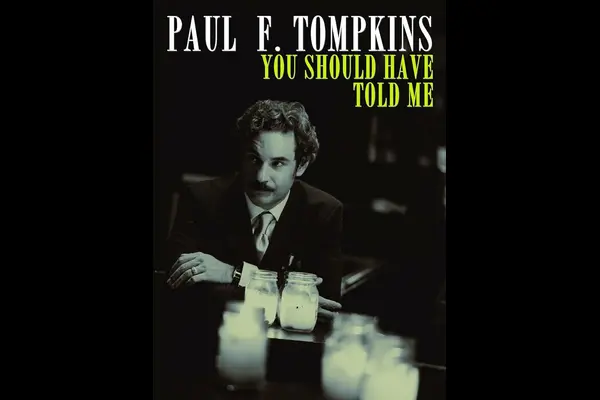
You Should Have Told Me
Comedy Central · 2010 · 59 min
An intimate hour about turning forty, buying property, and attending funerals.
Paul F. Tompkins strips away the cartoonish suits and theatrical arrogance of his earlier albums to try something quieter. Working a tiny stage, he aims his highly articulate frustration inward, turning himself into the punchline. The material relies on his usual extensive vocabulary and precise timing, but the focus shifts to ordinary life. He discusses turning forty, which he notes is the first age where you actually have to be a person.
The set was recorded over four nights at the 74-seat Laughing Skull Lounge in Atlanta. The venue was so small that he had to run a Twitter campaign to guarantee enough bodies for the Comedy Central taping. This performance sits right at the midpoint of his career evolution, bridging the gap between his conceptual early stand-up and the long-form narrative shows he developed later. He covers the stress of buying a first house and the social mechanics of a funeral, finding a way to recount his mother’s death by mocking the public performance of mourning. When guests offer their condolences, he decides the only proper response is to tell them they are not as sorry as he is. The title of the release comes from an equally grounded anecdote about throwing up in the back of a cab.
The set list
-
Throwing up in the back of a taxi cab
Recounted with gentlemanly decorum and an imaginary hat-tip, emphasizing the phrase that gave the special its title.
-
Turning 40 and shopping for a house
Adopted an exaggerated old-money snob caricature when confronted with a $1.4 million house, asking if the seller accepts gold or has room for spats.
-
Getting extremely high at a party and fixating on Anne Murray's 'You Needed Me'
Obsessively analyzing the ballad and concluding in a menacing whisper that he has been deeper inside the song than any actual fan.
-
His mother's death, wake, and funeral
An extended, vulnerable monologue about the uncomfortable public ritual of grief, his brother arriving late to the viewing, and drunkenly answering condolences with 'Not as sorry as I am.'
-
Atheism and lack of religious belief
Summarized his secular outlook by stating he is 'filled with the fire of nothing.'
-
Awkward interactions with neighbors in the laundry room
Dramatized neighborly small talk as an indictment of being caught soiling clothes in daily life.
How it plays
- Tone
- Dry, personal, vulnerable, and absurdly elegant.
- On stage
- Dapper, foppish, and sharply dressed in a mellow suit, employing an eloquent vocabulary and aristocratic decorum to recount squalid and deeply personal experiences.
- Pace
- Subdued and deliberate, trading aggressive swagger and rapid-fire absurdity for extended narrative pacing and a slowly considered monologue.
- About
- turning 40 and adulthood, binge drinking and youthful excess, grief, mourning, and his mother's death, atheism, house hunting and neighbors
What the critics said
Critically praised for successfully marrying Tompkins' gift for eloquent absurdity and caricature with grounded, cathartic, and emotionally honest personal narrative.
In the room: Intimate and focused inside a compact 74-seat room behind a bar.
Backstory
Crafted as a two-act story of adulthood reflecting on the excesses of youth and confronting adulthood, marriage, and the death and funeral of his mother.
Details
- Released
- Taped
- 2009, The Laughing Skull Lounge, Atlanta
- Runtime
- 59 min
- Where
- Comedy Central
- Director
- Neil Mahoney
- Topics
- Before
- Comedy Central Presents (2003)
- After
- Crying and Driving (2015)
More from Paul F. Tompkins
-
Crying and Driving
Comedy Central
-
Comedy Central Presents
Comedy Central
If you liked this
-
John Mulaney The Comeback Kid
Netflix
-
Sasheer Zamata The First Woman
YouTube
-
Trevor Noah African American
Showtime
-
Gary Gulman Born on 3rd Base
HBO Max
-
Gary Gulman It's About Time
Netflix