Live 2 - Politics
2004 · 68 min
A smug lecture testing the limits of public offense.
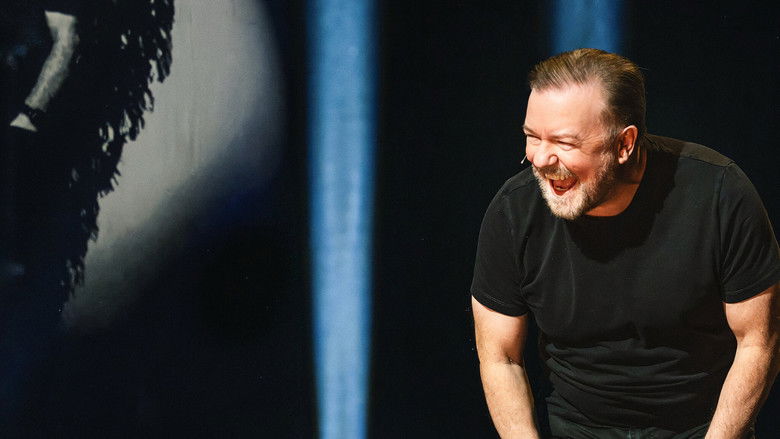
Gervais uses the theme of politics as a loose pretext to test how far he can push the boundaries of good taste. On stage, he acts less like a traditional stand-up and more like a smug, lecturing contrarian, pacing back and forth with a book of notes and a pint of water, treating the audience’s gasps as validation. He targets sensitive subjects, including the Holocaust, Stephen Hawking, and safe sex, not to make a grand political statement, but to mock the very idea of political correctness and the public’s appetite for offense.
Filmed at the Palace Theatre in London’s West End, this 2004 show caught Gervais at a career crossroads. He was fresh off the historic television success of The Office and wanted to prove he could command a stage as himself, rather than relying on his David Brent persona. While the connection to actual politics remains thin, the performance relies heavily on shock value and Gervais’s signature giggly arrogance. It secured his place on the UK touring circuit, even if critics noted that the structured, almost academic delivery lacked the loose, improvisational flow of his comedy peers.
The set list
-
Politics is everywhere sketch outside the Houses of Parliament
Gervais accosts a passing disabled man in a wheelchair to illustrate race, disability, and sexuality debates permeating daily encounters.
-
Performing at a Royal Albert Hall charity gig for teenage cancer
Gervais jokes that charity events are a pain with nothing in it for him, justifying arriving by helicopter to incur expenses.
-
Sponsoring a Rwandan child vs buying a Cabbage Patch Doll
Reacting to a charity ad comparison, Gervais calculates that paying five pounds a week until age eighteen would cost two grand, making the doll look like the cheaper deal.
-
Staying in a two-star Dunstable hotel during tour warm-ups
Navigating a hotel bar packed with wedding guests who immediately recognize him and shout his character name Brent.
-
Reinterpreting nursery rhymes as moral allegories
Satirically dissecting stories like The Boy Who Cried Wolf and Humpty Dumpty as flawed moral tales alongside critiques of Gandhi and Nietzsche.
How it plays
- Tone
- Satirical, irreverent, cynical, and unfiltered.
- On stage
- Irreverent, cynical, self-deprecating, and whip-smart, delivering monologue-style observational routines with empirical skepticism.
- Pace
- Fast-paced stream-of-consciousness monologue utilizing calculated theatrical pauses.
- About
- politics in everyday life, political hypocrisy, charity and child sponsorship, celebrity culture and fame, disability, nursery rhymes as moral allegories
What the critics said
Acclaimed for its unfiltered commentary, satirical observations of public and political hypocrisy, and sharply executed wit.
In the room: Energetic theater acoustic setting capturing live audience laughter and crowd meltdowns.
Backstory
Following his global breakthrough with The Office and winning Golden Globes earlier in 2004, Gervais authored and toured this material exploring everyday political and social absurdities prior to modern internet outrage culture.
Details
- Released
- Taped
- Palace Theatre, London
- Runtime
- 68 min
- Director
- Dominic Brigstocke
- Topics
- Before
- Ricky Gervais Live: Animals (2003)
- After
- Out of England (2008)
More from Ricky Gervais
-
Mortality
Netflix
-
Armageddon
Netflix
-
Supernature
Netflix
-
Humanity
Netflix
-
Out of England 2
HBO
-
Out of England
HBO


If you liked this
-
Ben Bankas Elect This
YouTube
-
Michelle Wolf The Well
Netflix
-
Jimmy Carr Natural Born Killer
Netflix
-
Simon Bird Debrief
Channel 4


