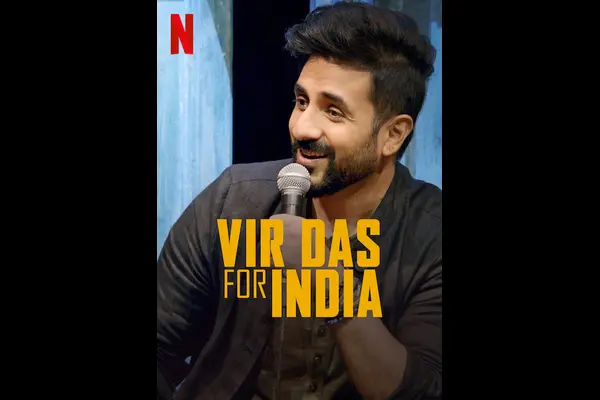
For India
Netflix · 2020 · 75 min
An intimate history of India told through snacks and colonial policy.
Vir Das spends this hour sitting on a set of wooden stairs in a dhoti, sipping tea from a clay cup and trying to explain his country through its junk food. The show eschews broad cultural generalizations in favor of highly specific childhood memories, like analyzing why parents force their kids to eat Chyawanprash—which he describes as peanut butter for people who hate their children—and how Parle-G biscuits inevitably disintegrate when dipped in tea.
Filmed at Mehboob Studios in Mumbai and released on Republic Day in 2020, the set arrived while Das was balancing his Indian touring career with a growing presence on American network television. The intimate staging positions a small group of foreigners in a brightly lit section of the audience, allowing Das to alternate between explaining Indian culture to outsiders and commiserating with locals. He ranges from the beige-obsessed colonial logic of the British to the medicinal qualities of Old Monk rum.
The performance earned an International Emmy nomination in 2021, cementing Das’s transition from a regional star to a fixture of global streaming comedy.
The set list
-
Everyday Indian food and drink staples like Parle-G, Chyawanprash, and Old Monk
Frames Parle-G as the world's greatest tea biscuit, Chyawanprash as peanut butter for parents who hate their kids, and Old Monk as a diplomatic tool, citizenship test, and drink of choice at the wrap party for colonialism with Gandhi.
-
British colonial policy and race
Jokes about the British mindset viewing themselves as 'beige'—oppressing anything darker than beige, and avoiding conflict with Germans who are lighter than beige.
-
The Jungle Book and Indian political leadership
Riffs on Indian names in The Jungle Book, creating a satirical parallel with 'Narendra Mowgli' becoming Prime Minister and forcibly hugging animals, with Sher Khan as home minister.
-
Elderly rigidity and ordering omelettes in Chinese restaurants
Uses the stubbornness of older Indian relatives demanding an omelette in a Chinese restaurant as an analogy for older political rulers imposing hatred onto the world's youngest population.
How it plays
- Tone
- Witty, celebratory, biting, and politically outspoken.
- On stage
- Seated on steps in front of a doorway wearing dhoti-pants and juttis, sipping from a kullad while offering candid, sharp, and satirical observations.
- Pace
- Rapid-fire punchlines delivered almost every alternate sentence, traversing diverse topics with high momentum and knowing poise.
- About
- Indian cultural identity, food, and nostalgia, Colonialism and British rule, Contemporary Indian politics and leadership, Bollywood and pop culture, Generational mindset differences
What the critics said
Critically praised as a sharp, fearless, and radical deep-dive into Indian culture and politics that blends nostalgic desi tropes with impactful satire, though some reviewers noted the sheer volume of topics and pacing could feel overwhelming.
In the room: An urban audience seated in split lighting sections, with foreign attendees spotlighted in the center, responding enthusiastically throughout the performance.
Backstory
Released on India's Republic Day in 2020 as a personal 'love letter' to his home country, framed around exploring universal Indian identity, colonial history, and the contemporary political climate.
Details
- Released
- Runtime
- 75 min
- Where
- Netflix
- Director
- Ajay Bhuyan, Vir Das
- Topics
- Before
- Losing It (2018)
- After
- Outside In – The Lockdown Special (2020)
More from Vir Das
-
Fool Volume
Netflix
-
Landing
Netflix
-
Losing It
Netflix
-
Abroad Understanding
Netflix
If you liked this
-
Matthew Broussard Hyperbolic
YouTube
-
Trevor Noah Lost in Translation
Comedy Central
-
Trevor Noah African American
Showtime
-
Sasheer Zamata The First Woman
YouTube
-
Alonzo Bodden Historically Incorrect
Showtime